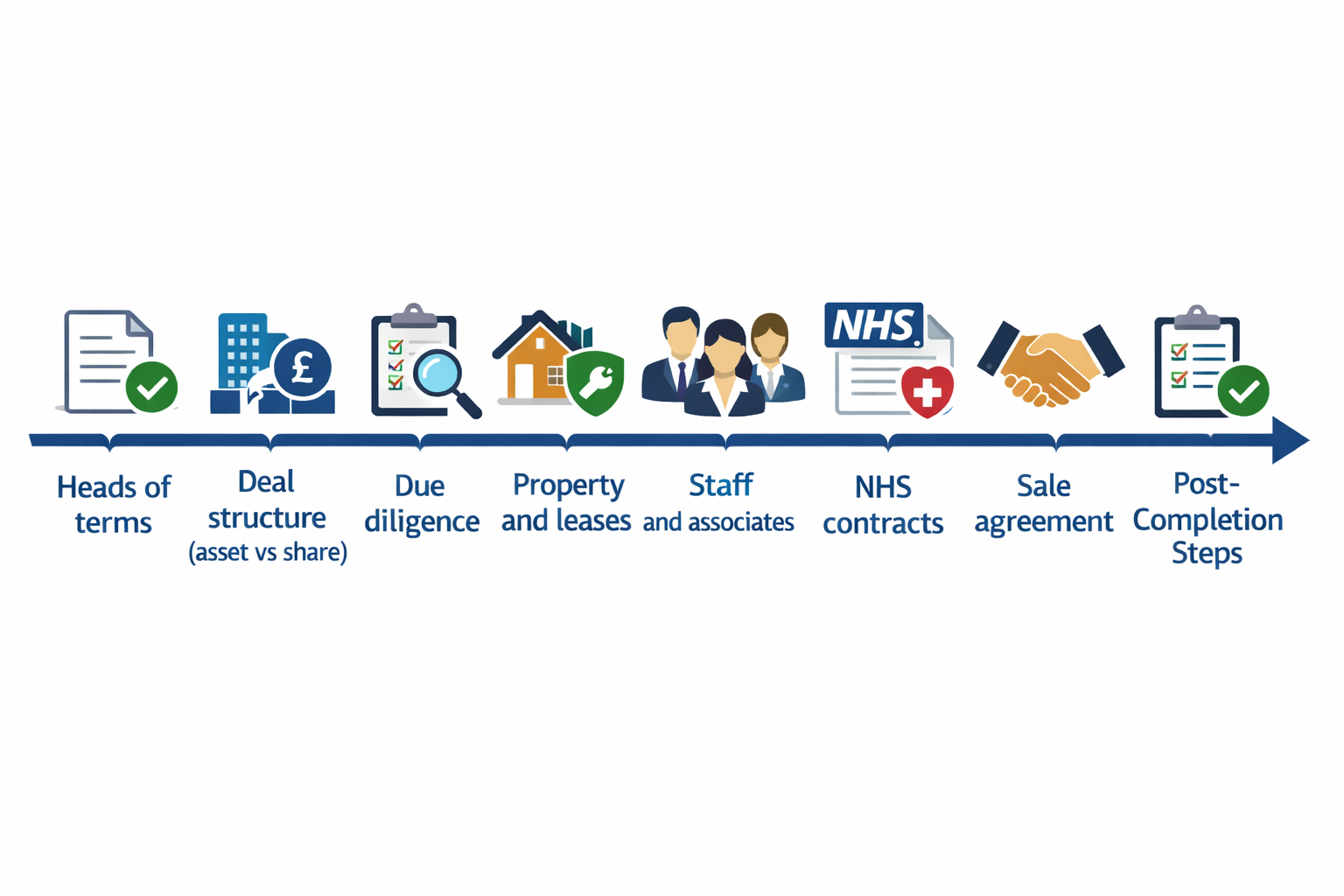
TL;DR: Buying a dental practice in England & Wales involves a structured legal process that runs from heads of terms through to post-completion obligations. This guide explains each legal stage of a dental practice purchase, how they interconnect, and why early decisions around structure, staff, property and NHS contracts often determine whether a transaction proceeds smoothly or becomes delayed.
In this guide:
- Heads of terms
- Deal structure (asset vs share)
- Due diligence
- Property and leases
- Staff and associates
- NHS contracts
- Sale agreement
- Post-completion steps
If you’re trying to understand how long the process usually takes in practice (and why transactions often extend beyond initial timetables), see: How Long Does It Take to Buy or Sell a Dental Practice?
Heads of Terms in a Dental Practice Purchase
Most dental practice purchases begin with an agreed price and heads of terms.
Heads of terms are usually non-binding. But they shape everything that follows. They typically record:
- Whether the deal is structured as an asset purchase or a share purchase
- Whether property is included
- The proposed timetable
By the time solicitors are instructed, these points are often already “agreed in principle”.
Where the implications of those decisions haven’t been fully understood, issues often emerge later in the process.
Nothing is legally committed at this stage, but the direction of travel is typically set.
Asset Purchase vs Share Purchase When Buying a Dental Practice
One of the most important legal decisions is whether the transaction involves:
- The assets of the practice, or
- The shares in a company that owns the practice
This choice affects:
- Which liabilities transfer
- How staff and associates are treated
- How property is dealt with
- Whether completion accounts apply
- How NHS contracts are handled
The structure determines the legal mechanics of the entire transaction.
A detailed comparison of asset purchases and share purchases when buying a dental practice is covered in Asset Purchase vs Share Purchase: What Dentists Really Need to Know.
Legal Due Diligence in Dental Practice Transactions
Once solicitors are instructed, the buyer’s solicitor carries out the due diligence exercise.
This involves reviewing legal and operational information about the practice:
- Corporate and contractual documents
- Employment and associate arrangements
- Property documentation
- Regulatory compliance
- Financial and operational disclosures
- NHS contract performance
This is where issues that slow or derail transactions most often emerge.
Problems typically arise where documentation doesn’t match how the practice operates. Associates working under contracts that expired years ago. Staff on terms never formalised. Lease arrangements that contradict what the seller described.
Due diligence findings inform what protections are included in the sale agreement.
Common causes of delay are covered in more detail here: Why Dental Practice Sales Take Longer Than Expected
Property and Lease Issues When Buying a Dental Practice
Property is one of the most frequent sources of delay.
Depending on the deal structure:
- Freeholds may need to be transferred
- Leases may need to be assigned or surrendered and regranted
- Landlord consent may be required
Even where property appears straightforward, lease terms can create obstacles. Consent requirements. Rent reviews. Break clauses.
Transactions can stall where landlords withhold consent or impose conditions that weren’t anticipated.
For an overview of lease issues that commonly disrupt dental practice transactions, see: The Lease Terms That Kill Dental Practice Sales
Property issues often dictate the transaction timetable more than any other factor.
Staff and Associates in a Dental Practice Purchase
Staff and associate arrangements depend entirely on the transaction structure.
In an asset purchase:
- Employed staff typically transfer under TUPE
- Self-employed associates do not transfer automatically
In a share purchase:
- The employer remains the same company
- Employment arrangements typically continue unchanged
These distinctions often surprise buyers, particularly where associates generate most of the practice income.
In an asset purchase, separate arrangements are required with self-employed associates. Where those arrangements cannot be agreed, the practice being acquired may differ from what was originally envisaged.
For further detail, see: TUPE When Buying a Dental Practice: Key Legal Points for Dentists and Buying a Dental Practice? Don’t Assume the Associates Come With It
Issues around staff and associates are often identified late, which can lead to renegotiation or delay.
How Do NHS Contracts Transfer When Buying a Dental Practice?
NHS contracts add a further layer of complexity to the transaction.
In a share purchase: The NHS contract often remains in place. Consent may be required for a change of control.
In an asset purchase: NHS contracts cannot usually be sold outright. The Partnership Route is commonly used to facilitate the transfer.
Understanding who holds the NHS contract, and how it will move (or remain in place), is relevant to the choice of transaction structure.
See NHS England’s official guidance on dental contracting (GDS and PDS agreements) for more information.
What Goes into the Sale Agreement?
The sale agreement records:
- What is being bought
- What protections apply
- How risk is allocated between buyer and seller
In share purchases: Completion accounts are often used. The final price adjusts after completion based on the company’s net asset position.
In asset purchases: The process is typically more straightforward, with fewer post-completion adjustments.
This is the stage where decisions (particularly around structure) can either simplify the process or create friction. The sale agreement reflects decisions made weeks or months earlier.
Post Completion Steps After Buying a Dental Practice
Completion is not the end of the legal process.
Post-completion work includes:
- Finalising completion accounts
- Registering property transfers
- Updating regulatory bodies
- Dealing with the NHS contract
Problems at this stage often trace back to issues not properly addressed earlier in the transaction.
How the Legal Process Fits Together
Buying a dental practice involves a sequence of interconnected legal stages.
The transaction structure (asset vs share purchase) affects liabilities, staff transfers, property arrangements, and NHS contracts. Most delays arise where early decisions are made without understanding their impact on later stages.
This article provides an overview of how the legal process works from start to finish. Each stage links to more detailed articles that explore specific issues commonly encountered in dental practice purchases.
All articles on BuyADentalPractice.co.uk are written by solicitors experienced in dental practice transactions in England & Wales.